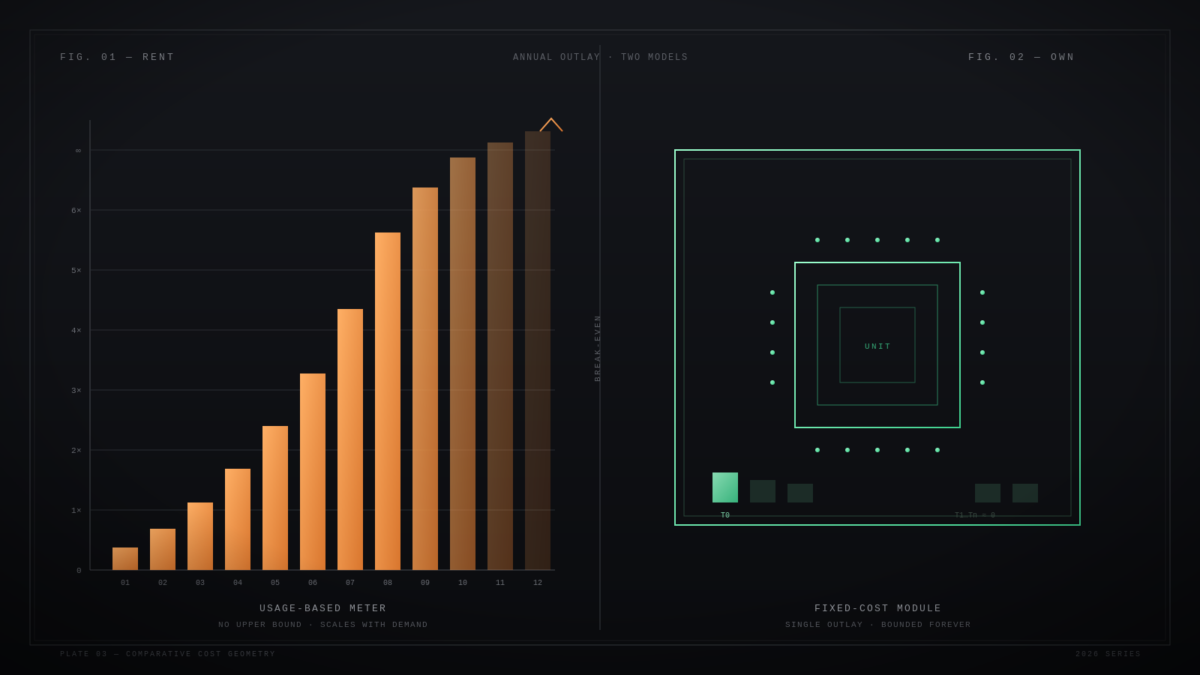

Local AI vs Cloud AI – Your Copilot Bill Just Exploded — And Nvidia Has the Perfect Comeback
June 11, 2026 · 6 min read · AI, Cloud, Hardware

Since June 1st, developers have been opening their GitHub Copilot bills and doing a double take. Some are reporting costs 10x, even 50x higher than what they considered normal usage. The sticker price of the subscription? Hasn’t moved a cent.
On the very same day, on the other side of the world, Nvidia and Microsoft unveiled at Computex a new kind of laptop capable of running massive language models locally — no cloud required. Calendar coincidence, or symptom of the same underlying problem? We’re betting on the latter.
The “all-you-can-eat” trap
Until May 31st, Copilot ran on a “premium requests” system: a fixed number of requests per month, regardless of what you asked the model to do. Starting June 1st, GitHub switched to “AI Credits” — credits calculated directly from real token consumption, priced at the actual API rates of the underlying models.
In practice: every request, every agent session, every line of generated code now consumes credits proportional to the real inference cost of the model. And agentic models — the ones that chain multiple reasoning steps to complete a task — are token-hungry by design.
The result: developers who used Copilot heavily watched their monthly allowance disappear in a single day. One user reported burning through 82% of their allotment in 24 hours. Others are projecting bills 10 to 50 times higher than before.
The price tag didn’t change — that’s exactly the problem
Copilot Pro stays at $10/month, Pro+ at $39, Business at $19 per user, Enterprise at $39. On paper, nothing changed. But these plans now cover only a fraction of real usage — beyond that, you’re billed per token at API rates.
And this isn’t just a coincidence of timing. Internal Microsoft documents leaked in April showed that Copilot’s weekly running costs had nearly doubled since January 2026. In other words: this isn’t a carefully planned product decision, it’s damage control.
Inference costs for agentic models became unsustainable for the company, and the bill is now landing on users.
The community reaction has been sharp. On Reddit and X, the mood is bitter: Microsoft spent months pushing developers toward heavy, “agentic” usage — and is now changing the rules right after the habit took hold.
Meanwhile, in Taipei: Nvidia’s anti-cloud weapon
That same day — June 1st — Nvidia took the stage at Computex to unveil the RTX Spark, a new “superchip” built with Microsoft to turn Windows into an operating system designed for local AI agents.
The numbers: a 20-core Arm processor co-developed with MediaTek, a Blackwell-generation GPU with 6,144 CUDA cores, and — most importantly — 128GB of unified LPDDR5X memory shared between CPU and GPU, with 300GB/s of bandwidth. All told, up to 1 petaflop of AI compute.
The game-changer is that unified memory: it lets large language models with up to 120 billion parameters run locally, with a context window of up to 1 million tokens — no internet connection, no API bill, no end-of-month surprise.
Don’t confuse it with the earlier DGX Spark, which stayed a niche product at $4,699 with disappointing memory bandwidth performance. The RTX Spark, by contrast, is aimed squarely at the mainstream: 14-to-16-inch laptops, as thin as 14mm and as light as 3 pounds, from Dell, HP, Lenovo, Asus, MSI, and Microsoft Surface starting fall 2026, with announced prices around $1,799 for entry-level models and $2,899 for high-end ones.

You don’t need a $2,000 laptop to start
Here’s the part that gets lost in headlines about 120-billion-parameter superchips: local AI is already quietly showing up in laptops people are buying anyway.
“Copilot+ PC” is a hardware standard Microsoft set back in 2024 — an NPU rated at 40 TOPS or more, plus 16GB of RAM. Those chips already run smaller models, in the 7-to-13-billion-parameter range, locally: live captions and translation, image generation, background blur, on-device search. According to research firm Omdia, AI PCs are on track to make up 55% of all computers shipped in 2026, climbing to 75% by 2029.
And in May 2026, at Build, Microsoft went further — dropping the requirement that on-device AI be limited to NPU-equipped Copilot+ machines, and opening it up to any GPU-accelerated Windows PC. Translation: a lot of people are about to get meaningful local AI on their next laptop without buying anything labeled “AI superchip” at all.

The real math: rent or buy?
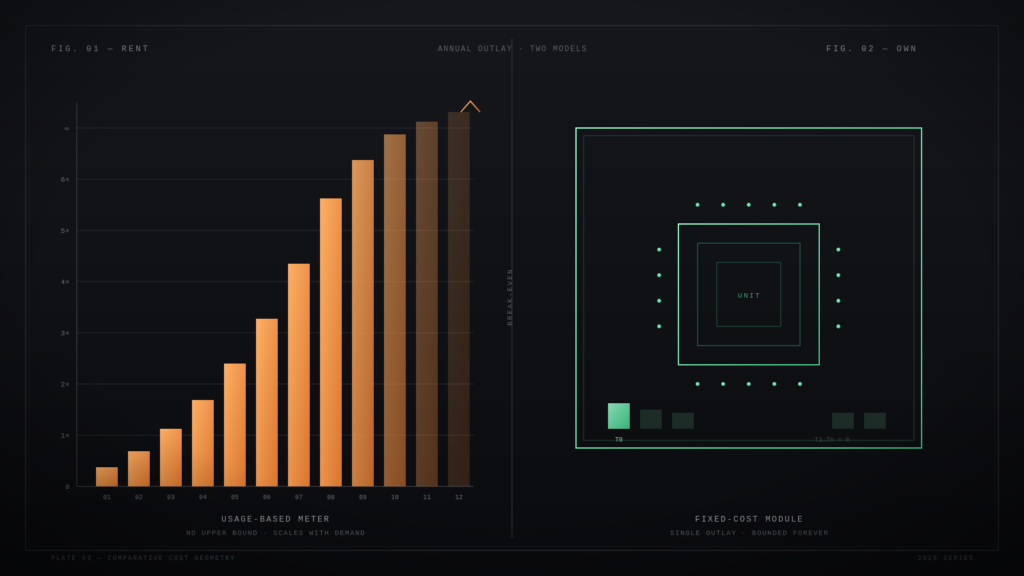
This is where the two stories collide. A Copilot Pro+ subscription at $39/month sounds trivial — until agentic usage pushes the real bill to $200, $400, sometimes $1,000 a month for a heavy user. Over two or three years, that adds up to thousands of dollars, with nothing to show for it at the end.
An RTX Spark laptop at $1,799–$2,899 is a heavier upfront investment. But it’s a fixed, one-time cost, amortized over the life of the machine — and it runs 120-billion-parameter models without depending on whatever the API rate happens to be that day.
This isn’t true for everyone: occasional usage is still cheaper in the cloud, by a wide margin. But for power users — exactly the people GitHub just hit hardest — the economics flipped sides in the span of a week.
The Bottom Line
For a while, “local AI” sounded like a niche trend — something for privacy nerds and cloud skeptics. This week, that narrative aged fast.
What’s happening with Copilot isn’t an isolated accident: it’s proof that “all-you-can-eat” agentic AI plans never reflected the real cost of inference. Companies subsidized mass adoption — and now that the habit is locked in, they’re no longer covering the difference.
The RTX Spark arrives at the exact moment this dynamic becomes visible to the public for the first time, in the form of real bills. And for the first time, it offers a credible alternative — not in some datacenter rack, but in a laptop sitting on your desk. You don’t even need the high-end version: the same shift toward “local by default” is already baked into the Copilot+ PCs and AI laptops filling store shelves this year.
The question isn’t “will the future be local or cloud?” anymore — it’s: how many billing shocks like Copilot’s will it take before buying an AI-capable laptop starts to look like the most rational decision of the year?
Sources: GitHub Blog — Copilot moving to usage-based billing (github.blog); TechCrunch — ‘What a joke’: GitHub Copilot’s new token-based billing spurs consternation (techcrunch.com); Tech Times — Copilot pricing change drives backlash (techtimes.com); Nvidia Newsroom — RTX Spark (nvidianews.nvidia.com); Tom’s Hardware — RTX Spark Superchip Computex 2026 (tomshardware.com); Tech Times — RTX Spark laptops fall 2026 (techtimes.com); Newegg — Copilot+ PC guide 2026 (newegg.com); Windows News — Build 2026 drops NPU-only requirement (windowsnews.ai)
